



Historic Folk Toys: Game, 'Bamboo Pick Up Sticks'
Bamboo Pick Up Sticks
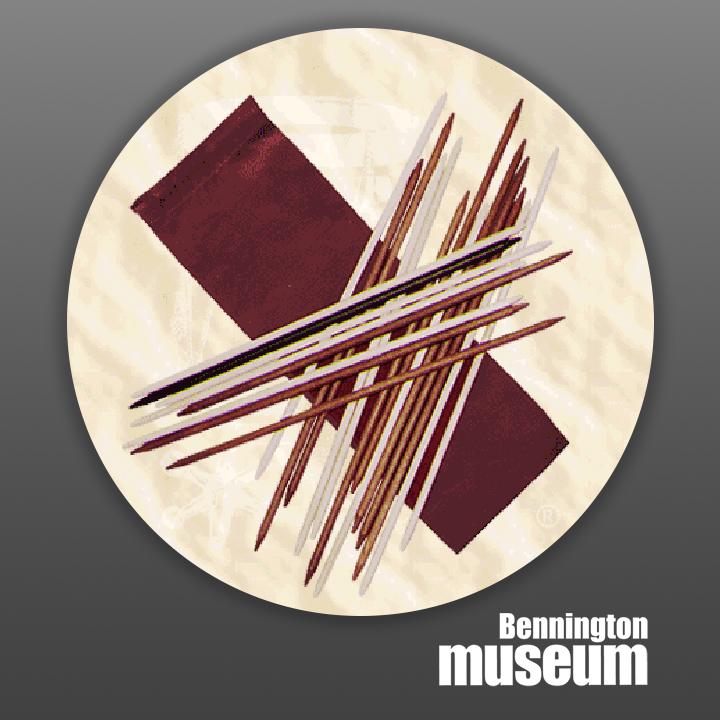
Our Bamboo Pick-Up Sticks are 7-1/8 inches long. The 41 sticks come packaged in a wooden box with a sliding lid. Box size is approximately 7-1/2 inches long by 1-3/4 wide by 1 inch high. Instructions and history are included.
Historical Background: Stick games appear in many cultures. In 12th-century China, sticks were first used in predictions. The sticks were scattered to "base the reading of destiny." There was one stick called the "emperor stick." This oracle practice was adapted by the Japanese in the 16th century. The Japanese Emperor was referred to as "Mikado" from the word "tsuchimikado." The Mikado version of pick-up sticks was brought to the United States in 1936 from Hungary. The name pick-up sticks may have come from this children's nursery rhyme:
One, two, buckle my shoe,
Three, four, shut the door,
Five, six, pick up sticks,
Seven, eight, lay them straight,
Nine, ten, a big fat hen."
Before the Mikado version of pick-up sticks appeared in America, this game had spread from China to Korea and Japan. This game appears to have spread to the Haida Indians of British Columbia as well as the Lenape Native American tribe in California via the Bering Strait or by ship across the Pacific Ocean. Native Americans played this game with straws of wheat and taught it to the early English settlers in the American colonies. This became a popular parlor game for young people during the Colonial and Victorian eras and is still enjoyed by children today.
Canadians refer to this game as "Spilikins," which is the name used by the British. A drawing of a set of intricately carved ivory spellicans (different spelling) is featured in R.C. Bell's book, "Board and Table Games from Many Civilizations." The British spellican sets, which feature carved bone or ivory, were imported from China.
If you wish to make your own mini set of pick-up sticks, use 31 round toothpicks and paint different colored stripes on them to represent different points. Make one stick a solid color or with just one stripe to represent the Mikado or "emperor stick." This stick can be used to assist picking up the other sticks after they are scattered or dropped. Keep score on paper and have some old-fashioned fun. The next time you play pick-up sticks, you will know that you are having fun just as children in ancient times did.
PACKAGE DIMENSIONS - 3 x 11 x 1.25"
Our Bamboo Pick-Up Sticks are 7-1/8 inches long. The 41 sticks come packaged in a wooden box with a sliding lid. Box size is approximately 7-1/2 inches long by 1-3/4 wide by 1 inch high. Instructions and history are included.
Historical Background: Stick games appear in many cultures. In 12th-century China, sticks were first used in predictions. The sticks were scattered to "base the reading of destiny." There was one stick called the "emperor stick." This oracle practice was adapted by the Japanese in the 16th century. The Japanese Emperor was referred to as "Mikado" from the word "tsuchimikado." The Mikado version of pick-up sticks was brought to the United States in 1936 from Hungary. The name pick-up sticks may have come from this children's nursery rhyme:
One, two, buckle my shoe,
Three, four, shut the door,
Five, six, pick up sticks,
Seven, eight, lay them straight,
Nine, ten, a big fat hen."
Before the Mikado version of pick-up sticks appeared in America, this game had spread from China to Korea and Japan. This game appears to have spread to the Haida Indians of British Columbia as well as the Lenape Native American tribe in California via the Bering Strait or by ship across the Pacific Ocean. Native Americans played this game with straws of wheat and taught it to the early English settlers in the American colonies. This became a popular parlor game for young people during the Colonial and Victorian eras and is still enjoyed by children today.
Canadians refer to this game as "Spilikins," which is the name used by the British. A drawing of a set of intricately carved ivory spellicans (different spelling) is featured in R.C. Bell's book, "Board and Table Games from Many Civilizations." The British spellican sets, which feature carved bone or ivory, were imported from China.
If you wish to make your own mini set of pick-up sticks, use 31 round toothpicks and paint different colored stripes on them to represent different points. Make one stick a solid color or with just one stripe to represent the Mikado or "emperor stick." This stick can be used to assist picking up the other sticks after they are scattered or dropped. Keep score on paper and have some old-fashioned fun. The next time you play pick-up sticks, you will know that you are having fun just as children in ancient times did.
PACKAGE DIMENSIONS - 3 x 11 x 1.25"